Contents:
A Fondness for Geophytes.
Geohyte is the term for a plant with an underground sotage structure: bulb (tulip, daffodil), corm (freesia, gladiolus), rhizome (iris), tuber (begonia, potato), ant tuerous root (ranunculus, dahlia).
It's not that crucial to know which kind of root you are buying, but there arae some differences in how they grow. Bulbs and tubers can grow bigger and bigger, blooming year after year, and often muliplying readily. Corms usually get used up as the plant grows and blooms, so you need reasonably rich, well-drained soil for them to produce new corms and continue for future years. Rhizomes grow outward at ground level, so we don't plant them as deep as the others and we give them room to spread. Rhizomes and tubers have multiple growing points, making them very easy to propagate and share with your friends: just cut them up.
For convenience, we call all of these "bulbs" and fall is the time to plant the flower bulbs that bloom in spring. Summer-blooming "bulbs" such as gladiolus and dahlias are planted in spring.
When we know where a plant comes from we can surmise its cultural requirements. Although we associate many bolba with Holland (where 65% of the world's flower bulbs are grown – 2002 figures), their ancestral geographic origins belie this heritage.
Take tulips. Hybrids such as the Darwin tulips prefer cold winters due to years of breeding for that. But tulips originally came to the Dutch from the Ottoman empire in the 16th century. Tulip species originated along the 40th latitude from western China to Turkey, spreading out to Afghanistan, Iraq, and Iran, and then west to the Mediterranean. So while the Dutch hybrids tend to bloom only for a year or so in our gardens, species such as T. clusiana, from warmer areas, will multiply and spread here.
Bulbs appear to be primarily an adaptation to aridity, especially dry summers. In fact, some of the largest bulb-like things in nature are from desert or chaparral areas. The Manroot, a cucumber relative native to Southern California, develops tubers that can reach 200 lbs! The plant grows very rapidly with the sparse winter rain, then lies dormant for months. Giant White Squill, a native of Crete, has bulbs that average 5 – 6 lbs. each.
Protection from winter cold is an added bonus of bulb formation, and a few require more winter chilling than we get in order to break dormancy properly: lily-of-the-valley and snowdrops are examples. But those are the exceptions. Most bulbs grow fine here.
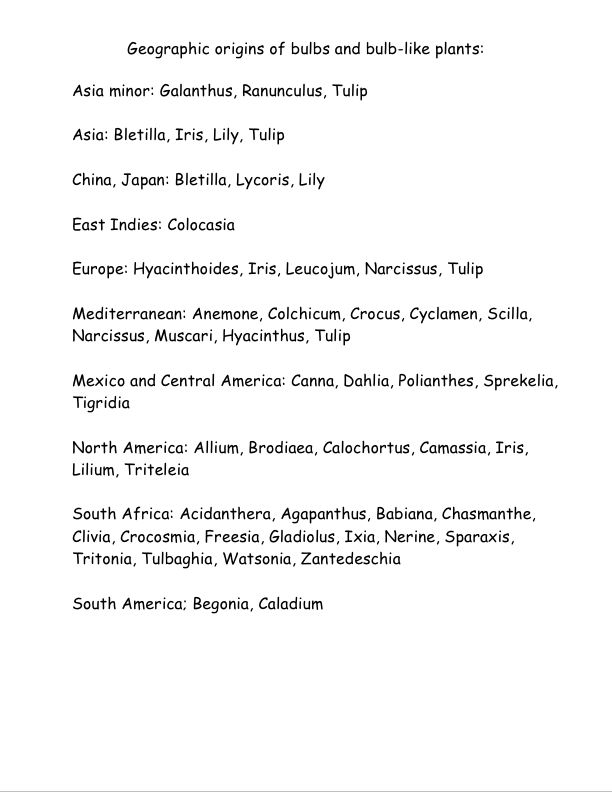
Geophyte geography: where is Asia minor, anyway?
Researching the origins of bulbs, I kept coming up with "Asia minor" for many species. Anemones and Ranunculus. Hyacinths and some Tulips. What is this region that is the source of so many of our favorites? I did well in high school geography, but that was decades ago. Nobody I asked could place it ("isn't that, like, west of China?").
Also known as Anatolia, Asia Minor is basically the Asian portion of modern Turkey (about 4% of Turkey is in Europe). Geographically it includes quite a range: the Mediterranean coast, where subtropical fruits such as citrus and figs are grown; high, dry plateaus, and east to even higher mountain ranges, including Mt. Ararat (nearly 17,000 ft.) at the border with Iran at the furthest east end of the region.
Mild-winter coasts, high mountains, with fertile valleys in between? Sounds a lot like Northern California. No wonder Ranunculus flourish for us! In fact, we are able to grow most bulb species that originate from cold climates, as well as those from mild-winter areas of both hemispheres. Two other major sources of bulbs for California gardens are the mild-winter, dry-summer regions of the Mediterranean and South Africa.
From the Mediterranean we get Crocus species, colchicums, cyclamen, grape hyacinths, several species of Narcissus, Scillas, and several more species of tulips. Giant hybrid crocus prefer a colder-winter area, but the species types do great here. Cyclamen hybrids are among our most popular winter-blooming flowers, perfectly hardy outdoors even on frosty nights. Most people don't even know they are a bulb, but you can save them from season to season. Just keep them dry during the summer.
The powerfully fragrant Narcissus papyraceus which we call Paperwhites, are from the Mediterranean. They sprout early, often blooming before Christmas, and spread rapidly in the garden – but in bulb catalogues from east-coast firms you'll find them consigned to the back pages as "indoor bulbs". Ah, the pleasure of living in balmy California: Mediterranean geophytes thrive here.
The Cape of South Africa is another region of winter rains, dry summers, and mild temperatures similar to California. The Cape boasts over 1500 species of geophytes, an amazing diversity: our ubiquitous Agapanthus (Lily-of-the-Nile, a tuberous root), old favorites such as freesia, gladiolus, and calla lily, and lesser-known choices such as Crocosmia, Ixia, Sparaxis, and Watsonia. All of these latter bloom and multiply freely here, yet are too tender for gardeners in colder areas.
Sorting them: Tulips and Daffodils
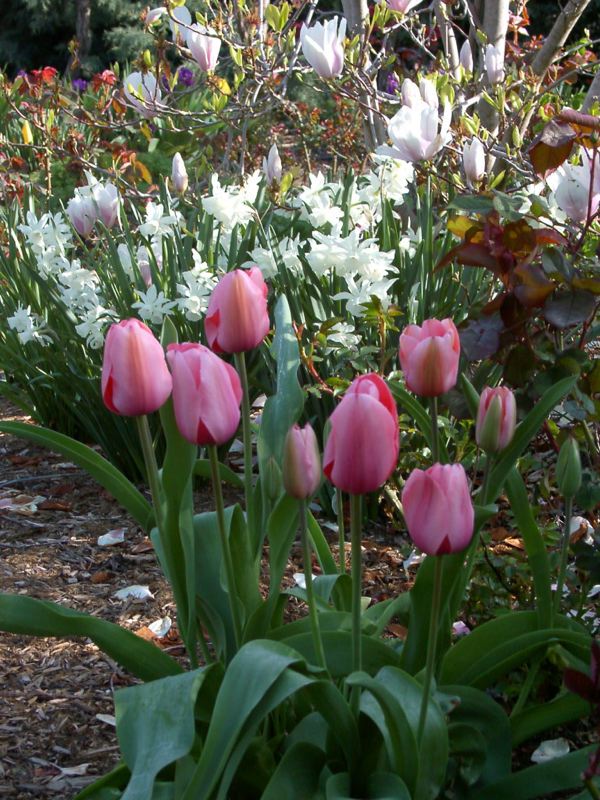
Tulips
Tracing the
origins and relationships of these older bulb types and giving them proper
names is complicated. Why? Because gardeners had been growing, propagating, and
breeding them for a couple of hundred years before the whole science of plant
relationships (taxonomy) and system of naming (botanical nomenclature) was
invented. DNA research is revealing some interesting relationships, but many
are complex hybrids.
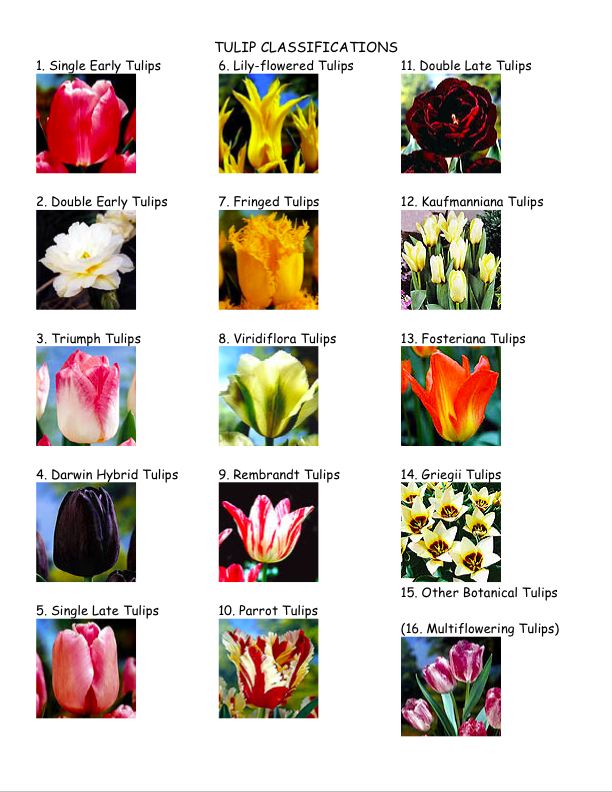
In this situation, horticultural taxonomists will sort cultivars into groups based on similarity of flower form or bloom period. In the case of tulips there are over 2000 cultivars, in 15 recognized categories such as Single Early, Darwin Hybrid, Lily-flowered, etc. Hybrids known to be mostly from a particular species bear that name: the Fosteriana tulips, also known as Emperors, have at least some T. fosterana parentage (they also happen to be good choices here).
By the way, we can grow the old-fashioned, long-stem tulips here. Just don't plant them too early. Wait until the soil has cooled (Nov. – Jan.), and plan on planting new ones each year. That said, I have seen tulips repeat, sometimes for years, when they are planted where they get little or no summer watering. Follow the same instructions for hyacinths: plant Nov. – Jan., and if you want them to repeat put them where they will be dry in summer.
Tulips come in nearly every color, including black, as well as striped, fringed, and freakish forms. Hyacinths come in strong primary colors, including true blue.
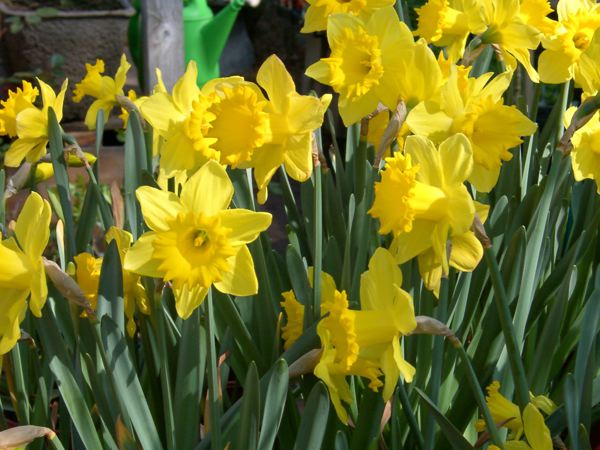
Daffodils and narcissus
come in yellow, white, and pink. Although some species of
Narcissus (the genus which
includes daffodils) grow wild in Europe, their great popularity as garden
plants came later: in the late 19th century and early 20th
century hundreds of hybrids were developed using species found in Asia and the
Mediterranean.
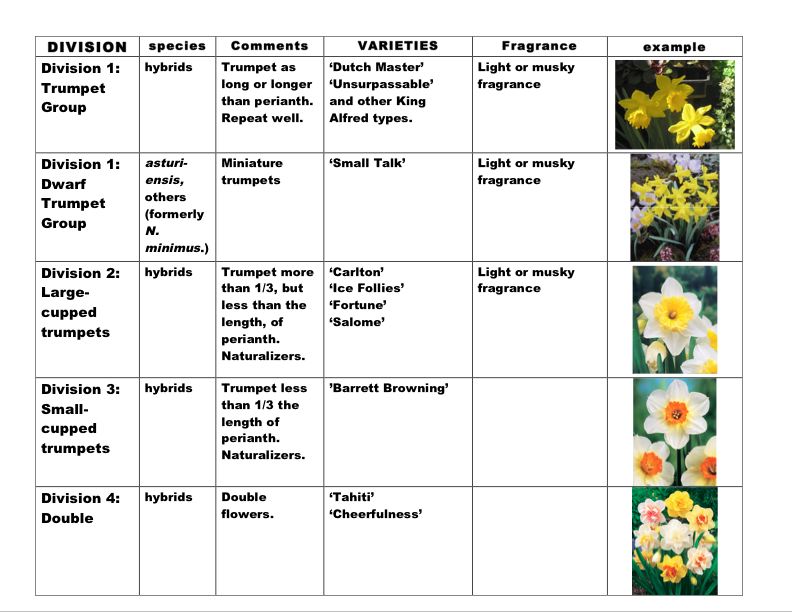
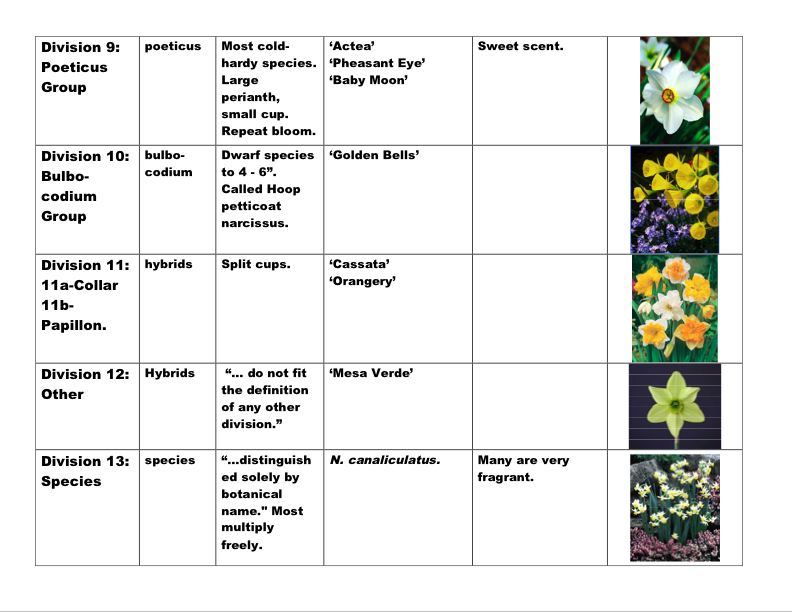
Today there are over 3000 cultivars, sorted into groups called divisions. Because the parentage is somewhat better known, the divisions other than the biggest-flowered types reflect the species they resemble.
* If you want the familiar big-flowered ones, plant Trumpet daffodils. They'll repeat year after year, but usually don't increase.
* If you like novelty flowers, try the Split-cup and Double forms. My experience is they don't return as well in future years.
* If you want big, showy flowers on plants that multiply, plant Large-cup and Small-cup types, and the dwarf Trumpets.
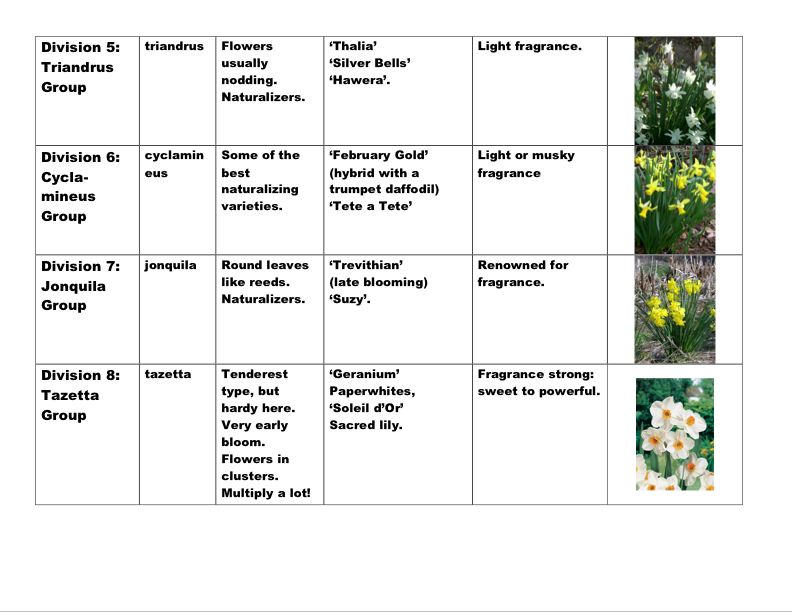
* If you want super-fragrant blooms on plants that will multiply even more freely, plant from among the other divisions: Cyclamineus, Tazetta, Triandrus. For elegant flowers, try the tall, late-blooming Poeticus narcissus.
* For cute little plants that multiply exuberantly, nearly all extra fragrant, plant some of the species types.N. canaliculatus (6" tall!) and N. jonquilla simplex (12") can be crowded in a pot and brought indoors in bloom to perfume the whole house.
Whichever you choose, all daffodils and narcissus are easy to grow and most will give years of bloom.
I counted over 100 species of flowering bulbs that grow readily in our gardens in the Sacramento Valley! Geophytophiliacs know that I've only scratched the surface here. The bulb is truly the gardener's friend: easy to plant, and productive for many years.
Bulbs: A chart
| GENUS | SPECIES | COMMON NAME | Comments | origin | root type | season sold |
|---|---|---|---|---|---|---|
| Acidanthera | bicolor | Abyssinian sword lily | see Gladiolus callianthus | South Africa | corm | Spring |
| Agapanthus | africanus | Lily-of-the-Nile | Many new varieties: 'Elaine', 'EllaMae', 'Mood Indigo'. Dwarf and very tall forms. Most evergreen, some deciduous. | South Africa | rhizome | Fall or spring |
| Allium | species | Ornamental alliums (onions) | Many species and hybrids! |
Northern Hemisphere, including US | bulb | Fall |
| Anemone | coronaria | Windflower | Weird looking roots. Plant scarred side up. Poisonous. | Mediterranean, Asia minor, North America, Japan | tuber | Fall |
| Babiana | stricta | Baboon flower | Cute little flowers. Naturalizes well here. Baboons eat the corms (really). | South Africa | corm | Fall |
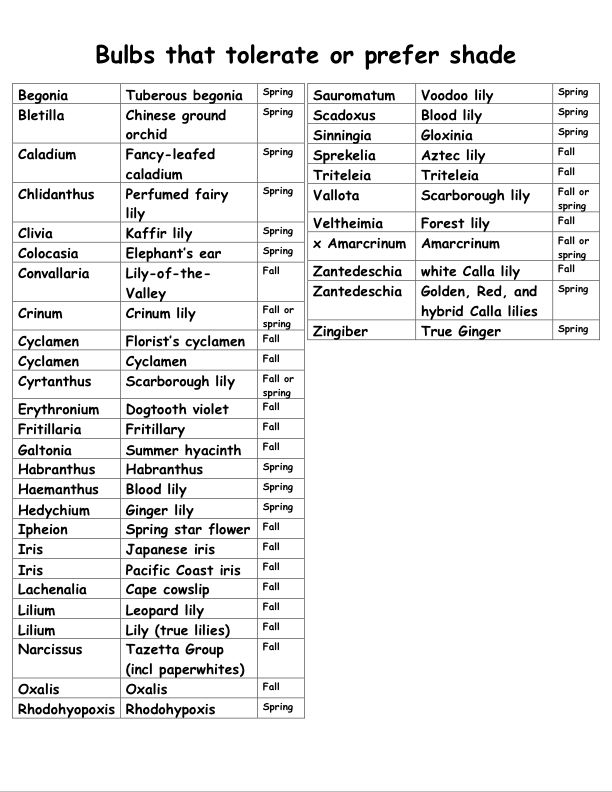
| Begonia | x tuberhybrida | Tuberous begonia | Rich, fast-draining soil, partial shade. | South America | tuber | Spring |
| Belamcanda | chinensis | Blackberry lily | Sprays of spotted flowers. Seeds look like blackberries, used in arrangements. | China, Japan | rhizome | Fall |
| Bletilla | striata | Chinese ground orchid | Very easy, very hardy.Great shade perennial. | Asia | pseudobulb | Spring |
| Brodiaea | species | Brodiaea | CA native. Tolerate poor soil. | Western US | corm | Fall |
| Caladium | x hortulanum | Fancy-leafed caladium | Rich, fast-draining soil. Great in pots. Shade-lovers. | South America (tropics) | tuber | Spring |
| Calochortus | species | Mariposa lily | Includes CA natives. Keep dry in summer. | Western US | bulb | Fall |
| Camassia | species | Camass, Quamash | Includes CA natives. C. quamash is edible and nutritious. | Western US | bulb | Fall |
| Chasmanthe | species | Chasmanthe | Multiply rapidly. | South Africa | corm | Fall |
| Chionodoxa | luciliae | Glory-of-the-snow | Native to alpine meadows, not fond of hot dry climates | Eastern Mediterranean: Crete, Cyprus, Turkey | bulb | Fall |
| Chlidanthus | fragrans | Perfumed fairy lily | Incredibly fragrant. Rare, shy bloomer. Barely hardy here. | Andes (Peru) | bulb | Spring |
| Clivia | miniata | Kaffir lily | Need protection from frost. Will tolerate deep shade. | South Africa | rhizome | Spring |
| Colchicum | species | Autumn crocus | Plant in late summer. Bloom in fall. Poisonous. | Mediterranean | corm | Fall |
| Colocasia | esculenta | Elephant s ear | Lush tropical leaves. May rot if winter is cold and wet. May cause skin irritation. | East Indies, tropical Asia | tuber | Spring |
| Convallaria | majalis | Lily-of-the-Valley | Multiply but don t rebloom well here. Poisonous. | Europe | rhizome | Fall |
| Crinum | species | Crinum lily | Big, dramatic plants with tall fragrant flowers. Poisonous. | South Africa, Asia, Australia, Americas | bulb | Fall or spring |
| Crocosmia | species and hybrids | Montbretia | Formerly Tritonia. Multiply freely, have naturalized in many areas. Great cut flowers. Two species, lots of hybrids. | South Africa | corm | Spring |
| Crocus | hybrids | giant Crocus | Rebloom, but species types spread more. | Mediterranean | corm | Fall |
| Crocus | species | Crocus | species types naturalize here. | Mediterranean | corm | Fall |
| Cyclamen | persicum | Florist's cyclamen | Usually sold as potted winter plants. Bloom into spring, then go dormant. Will return in fall if kept dry during summer. | Mediterranean | tuber | Fall |
| Cyclamen | species | Cyclamen | Cute little plants with delicate-looking flowers fall - spring. Grow in partial shade. | Mediterranean | tuber | Fall |
| Cyrtanthus | elatus | Scarborough lily | Formerly Vallota speciosa. Frost sensitive. Looks like a Hippeastrum (Amaryllis). Evergreen. | South Africa | bulb | Fall or spring |
| Dahlia | hybrids | Dahlia | Hundreds of border, bedding, and cutting varieties. | Mexico and Central America | tuberous root | Spring |
| Dietes | vegeta | Fortnight lily | D. bicolor is yellow. Usually sold in pots. Tough, drought tolerant; overused. | South and East Africa | rhizome | Fall or spring |
| Endymion | species | Bluebells | See Hyacinthoides. Formerly Scilla. | Western Europe, northern Africa | bulb | Fall |
| Eremurus | species | Foxtail lily | Fragile roots, rot easily, prefer colder climate. | Western and Central Asia | tuberous root | Fall |
| Erythronium | species | Dogtooth violet | Includes CA natives (woodland areas). | Europe, Asia, North America |
bulb | Fall |
| Eucomis | bicolor, comosa | Pineapple lily | Easy to grow, but uncommon. Like organic material. | South Africa (tropical) | bulb | Fall |
| Freesia | hybrids | Freesia | Tender elsewhere, but hardy outside here. Older species, white, yellow, and certain varieties are most fragrant. | South Africa | corm | Fall |
| Fritillaria | species | Fritillary | Includes CA natives (woodland areas). Not happy in hot, dry climates. | North America, Europe, Asia | bulb | Fall |
| Galanthus | species | Snowdrops | Prefer colder winter areas. Poisonous. | Asia minor | bulb | Fall |
| Galtonia | candicans | Summer hyacinth | Big plant (2' - 3' leaves) with white, fragrant flowers on tall spikes. | South Africa | bulb | Fall |
| Gladiolus | callianthus | Abyssinian sword lily | = Acidanthera bicolor | South Africa | corm | Spring |
| Gladiolus | communis byzantinus | Byzantine gladiolus | Summer-blooming, wilder looking than garden glads. Multiply. | South Africa | corm | Spring |
| Gladiolus | hybrids | Garden gladiolus | Plant March - June. Bloom 12 - 16 weeks after planting. | South Africa | corm | Spring |
| Gladiolus | tristis | species Gladiolus | Little flowers, more delicate-looking than other glads. Fragrant at night. | South Africa | corm | Spring |
| Habranthus | species | Habranthus | Similar to Zephyranthes. | Southwest US to Argentina | bulb | Spring |
| Haemanthus | Blood lily | See Scadoxus | central and southern Africa | bulb | Spring | |
| Hedychium | species | Ginger lily | Not totally hardy; foliage will be damaged, but roots survive. Wonderful flowers. | Asia, India, Himalayas | rhizome | Spring |
| Helianthus | tuberosus | Jerusalem artichoke | 6' + plant, showy little sunflowers, spreads vigorously. Tubers are edible ("sunchokes"). | Eastern US | tuber | Spring |
| Hemerocallis | hybrids | Daylily | Mostly sold blooming in pots. Thousands of varieties. | Japan, Europe | tuberous root | Fall |
| Homeria | collina | Homeria | = Moraea collina. Interesting orange flowers. Easy. | South Africa | corm | Spring |
| Hyacinthoides | hispanica | Spanish bluebell | Formerly Scilla, formerly Endymion (sigh). Easy, bloom year after year, will tolerate shade. Excelsior is a selected form. | Spain, North Africa | bulb | Fall |
| Hyacinthoides | non-scripta | English bluebell, Wood hyacinth | Formerly Scilla, formerly Endymion (sigh). Easy, bloom year after year, will tolerate shade. Fragrant. | Western Europe | bulb | Fall |
| Hyacinthus | orientalis | Hyacinth | Plant after soil cools (Nov. - Dec.). Will rebloom but flower spikes will be looser after first year. Bulbs irritate skin; wear gloves. | Mediterranean, Asia minor | bulb | Fall |
| Hymenocallis | x festalis, narcissiflora | Spider lily, Peruvian daffodil | Large, fragrant, interesting flowers. May be damaged in winter. | Southern US, South America | bulb | Fall or Spring |
| Ipheion | uniflorum | Spring star flower | Formerly Brodiaea, formerly Triteleia. Spreads like crazy. Can even grow and bloom in lawn. | Argentina, Uruguay | bulb | Fall |
| Iris | ensata | Japanese iris | = I. kaemperi. Huge blossoms, very elegant on narrow, upright plants. Need lots of moisture, prefer acid soil. Can stand in water. | Japan | rhizome | Fall |
| Iris | germanica | Bearded iris | Thousands of varieties in seven classes sorted by height. Easy to grow in sun, light shade. Drought tolerant, not fussy about soil. | Southern Europe? | rhizome | Fall |
| Iris | orientalis | Spuria iris | = I. ochroleuca. Like giant Dutch iris, but evergreen. Tough, tall, spreading plants. Drought tolerant. | Asia | rhizome | Fall |
| Iris | Pacific Coast x | Pacific Coast iris | Hybrids of Western US natives, including I. douglasiana. Need good drainage, rot easily. Light shade best. | Western US | rhizome | Fall |
| Iris | species and hybrids | Iris, Dutch and dwarf | --Dutch Iris (actually from Spain and Portugal) --Dwarf species include: Iris cycloglossa Iris danfordiae Iris dardanus Iris histrioides Iris reticulata bucharica Iris reticulata Iris tuberosa |
Northern hemisphere | bulbs | Fall |
| Ixia | maculata hybrids | African corn lily | Should be grown more. Easy, multiplies, great cut flowers. | South Africa | corm | Fall |
| Ixiolirion | tataricum | Ixiolirion | Easy, multiplies. | Siberia | bulb | Fall |
| Lachenalia | species | Cape cowslip | Frost tender here. | South Africa | bulb | Fall |
| Leucocoryne | species | Glory-of-the-sun | Similar to Brodiaea. | Chile | corm | Fall |
| Leucojum | aestivum | Summer Snowflake | Spreads freely. Actually blooms in early spring. | Southern Europe, Mediterranean | bulb | Fall |
| Lilium | pardalinum | Leopard lily | CA native sometimes available from specialists. | California and Oregon | bulb | Fall |
| Lilium | species and hybrids | Lily (true lilies) | Categories of lilies include: Asiatic Hybrid Longiflorum - Asiatic Chinese Trumpet Tigrinum Oriental Orienpet Species |
Northern hemisphere, temperate zones | bulb | Fall |
| Lycoris | species | Spider lily | Several species; L. radiata and L. squamigera are most common. Bloom in late summer, like Amaryllis belladonna. | China, Japan | bulb | Fall |
| Muscari | armeniacum | Grape hyacinth | One of the most prolific multipliers; also reseeds. | Mediterranean region, Asia minor | bulb | Fall |
| Muscari | species and hybrids | Grape hyacinth | Several species and hybrids |
Mediterranean region, Asia minor | bulb | Fall |
| Narcissus | cyclamineus | Division 6: Cyclamineus Group | Excellent naturalizing varieties. February Gold, one of the best, is a hybrid between N. cyclamineus and a trumpet daffodil. 'Tête-à-Tête' is an even more miniature trumpet. | Spain, Portugal | bulb | Fall |
| Narcissus | poeticus | Division 9: Poeticus Group | Most cold-hardy species. Large perianth, small cup. | Spain to Greece | bulb | Fall |
| Narcissus | species and hybrids | Daffodils & Narcissus | Hybrid Narcissus, including daffodils, are sorted into 14 classes based on flower form and parentage. |
Mediterranean and Europe | bulb | Fall |
| Narcissus | tazetta | Division 8: Tazetta Group | Tender species, though hardy enough in California. Flowers in clusters. Popular for indoor bloom. Examples: 'Geranium'; 'Ziva' and other paperwhite types. | Spain to Portugal, Mediterranean, Iran to China and Japan | bulb | Fall |
| Narcissus | viridiflorus | unusual species | Autumn flowering | Gibraltar | bulb | Fall |
| Nerine | bowdenii | Nerine | Bloom in late summer long after foliage dies down. This is the most common species. Several others do very well here also. | South Africa | bulb | Fall |
| Oxalis | hirta | Oxalis | Other species: O. purpurea Native: O. oregona Weed: O. pes-caprae |
South Africa, South America | bulb | Fall |
| Pardancanda | norrisii | Candy lily | Usually grown from seed. Belamcanda X Pardanthopsis | hybrid origin | rhizome | Spring |
| Polianthes | tuberosa | Tuberose | Needs long warm season. Incredible fragrance. May not bloom first year. | Mexico | rhizome | Spring |
| Puschkinia | scilloides | Puschkinia | Best in colder-winter areas. | Asia minor | bulb | Fall |
| Ranunculus | asiaticus | Ranunculus | Plant in fall to get plant established for mass of spring bloom. Plant prongs down. Protect from birds when young. Replant each year. | Asia minor | tuberous root | Fall |
| Rhodohyopoxis | baurii | Rhodohypoxis | Vivid flowers in spring and summer, on a low plant. Best dry in winter (under overhang, or in pots). Root structure is botanically unusual. | South Africa | rhizome | Spring |
| Sauromatum | guttatum | Voodoo lily | Oddity with purple spotted, smelly flowers in late winter. | India | tuber | Spring |
| Scadoxus | multiflorus katherinae | Blood lily | Tender. Grow in a pot, keep moist. Good greenhouse or patio plant. | central and southern Africa | bulb | Spring |
| Schizostylis | coccinea | Crimson flag, Kaffir lily | Tough, easy plant similar to Watsonia and Gladiolus, but autumn blooming. | South Africa | rhizome | Spring |
| Scilla | peruviana | Peruvian squill | Bulb with vivid blue flowers in April. Multiplies freely. Very
tough, drought tolerant. A native of southwest Europe, not of Peru. |
Mediterranean | bulb | Fall |
| Sinningia | speciosa | Gloxinia | House or greenhouse plant with giant velvet flowers in summer, fuzzy leaves. Unhappy below 65F. | Mexico, Brazil | tuber | Spring |
| Sparaxis | tricolor | Harlequin flower | Showy tricolor flowers. Plants multiply readily. Easy. | South Africa | corm | Fall |
| Sprekelia | formosissima | Aztec lily | Increases steadily. Showy red flowers. Will rebloom after dry periods. | Mexico | bulb | Fall |
| Sternbergia | lutea | Sternbergia | Fall blooming, looks like a giant yellow crocus. | Western Mediterranean to central Asia | bulb | Fall |
| Tigridia | pavonia | Shell flower | Blotched, spotted flowers in hot colors. Blooms open morning to mid-afternoon. | Mexico | bulb | Spring |
| Triteleia | species | Triteleia | Like Brodiaea, which they used to be called. Grassy foliage, trumpet-shaped meadow flowers. CA natives. | Western US | corm | Fall |
| Tritonia | crocata | Tritonia | Very similar to Crocosmia, equally easy. | South Africa | corm | Fall |
| Tulbaghia | species | Society garlic, Wild garlic | Several species, some with sweet-scented flowers (T. simmleri, formerly T. fragrans). Foliage of T. violacea smells like garlic. Tough, tolerant of drought, can stand in water. | South Africa | rhizomes | Spring |
| Tulip | hybrids | Hybrid tulips are grouped into 16 classes, based on flower form and bloom season. | Europe and Asia | bulb | Fall | |
| Tulip | species | Europe and Asia | bulb | Fall | ||
| Tulipa | acuminata | Horned tulip | eastern Mediterranean | bulb | Fall | |
| Tulipa | bakeri | = T. saxatilis. 'Lilac Wonder' is most common. | Crete, Southwest Turkey | bulb | Fall | |
| Tulipa | batalinii | 'Red Gem' is common variety | Turkestan | bulb | Fall | |
| Tulipa | clusiana | Lady tulip | 12". Great in the Valley; spreads rapidly by droopers which are small bulbs that form at the end of the root. | Iran to Himalayas | bulb | Fall |
| Tulipa | clusiana chrysantha | 8". Naturalizes | Afghanistan | bulb | Fall | |
| Tulipa | dasystemon | Naturalizes well | Central Asia | bulb | Fall | |
| Tulipa | fosterana | May naturalize in areas with warm, dry summers. Emperor tulips derive from this species. | Iran | bulb | Fall |
| Tulipa | greigii | Variegated foliage. Large flowers for a species tulip. Examples: 'Oriental Splendor', 'Red Riding Hood' | Iran | bulb | Fall | |
| Tulipa | humilis | T.h. violacea = The Red Crocus tulip | Western Asia, Caucasus | bulb | Fall | |
| Tulipa | kaufmanniana | Low grower with large flowers. Will multiply if drainage is good. | Turkestan | bulb | Fall | |
| Tulipa | kolpakowskiana | Great naturalizer. | Central Asia | bulb | Fall | |
| Tulipa | linifolia | Naturalizes. | Central and Western Asia | bulb | Fall | |
| Tulipa | marjoletti | Afghanistan | bulb | Fall | ||
| Tulipa | praestans | 10". 4 - 6 flowers per bulb, opening slowly over several weeks. 'Fusilier' is the common variety. | Central Asia | bulb | Fall | |
| Tulipa | saxatilis | 7". Broad leaves. Multiplies by stolons. | Crete, Southwest Turkey | bulb | Fall | |
| Tulipa | sprengeri | 12". Tolerates shade. | Turkey (wooded mountains) | bulb | Fall | |
| Tulipa | sylvestris | 15". Daffodil yellow. Plant very deep (7") .Multiplies by stolons. | England and Iran. | bulb | Fall | |
| Tulipa | turkestanica | Multi-flowering, naturalizes. | Turkestan | bulb | Fall | |
| Tulipa | vvedenskyi | Tangerine Beauty | Russia | bulb | Fall | |
| Urginea | maritima | Sea onion, Giant white squill | Amazing 5+ lb. bulbs. Big, bold leaves grow in spring, die down in summer, then giant spikes (wand-like) emerge, grow to 5 or more, with white flowers. Great in flower arrangements. Hot, dry areas are perfect. | North Africa, Mediterranean, Europe, India | bulb | Fall |
| Vallota | speciosa | Scarborough lily | Now Cyrtanthus elatus | South Africa | bulb | Fall or spring |
| Veltheimia | bracteata | Forest lily | Hardy to 25F. Glossy, attractive leaves; showy flowers in winter. | South Africa | bulb | Fall |
| Watsonia | species | Watsonia | Many hybrids in shades of white, red, pink, orange. W. aletroides has coral colored flowers in spring. Great cut flowers. | South Africa | corm | Spring |
| x Amarcrinum | memoriacorsii | Amarcrinum | Big plants with tall fragrant pink flowers. Amaryllis belladonna x Crinum moorei. | South Africa, Asia, Australia, Americas | bulb | Fall or spring |
| Zantedeschia | aethiopica | white Calla lily | Very tough perennials for shade. Can take wet, even soggy soil. 'Green Goddess' has green tips. | South Africa | rhizome | Fall |
| Zantedeschia | species and hybrids | Golden, Red, and hybrid Calla lilies | Some amazing colors now available. Fussy; rot very readily. | South Africa | rhizome | Spring |
| Zephyranthes | candida | Fairy lily, Rain lily | Bloom in late summer, or anytime they've had a dry period and then get watered. | WesternHemisphere | bulb | Fall |
| Zingiber | officinale | True Ginger | Flowers aren't showy. Easy enough to grow for the roots, used in cooking. Simplest in pots; may rot in cold, wet soil. | Asia, India, Himalayas | rhizome | Spring |
Bulb toxicity
- Colchicum, Convallaria, Gloriosa
Toxic if eaten:
- Arisaema, Arisarum, Arum, Dracunculus
Harmful if eaten:
- Amaryllis, Galanthus, Iris, Narcissus, Ornithogalum, Scilla
Skin irritant:
- Alstroemeria, Arum, Hyacinthus, Iris, Narcissus, Ornithogalum, Scilla, Tulipa
Narcissus divisions
Tulip classifications
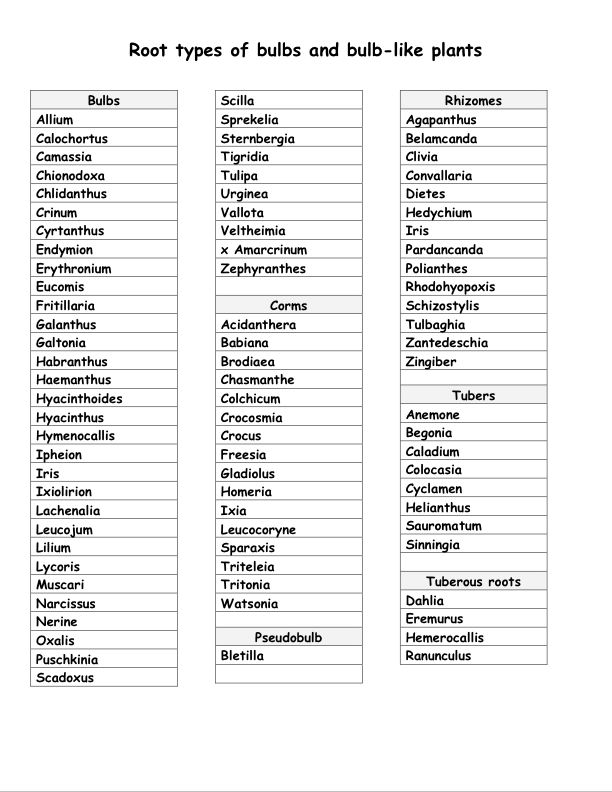
Root types